
Oct 2013
Coca-Cola Saved My Life
Coke: Getting more people more active.
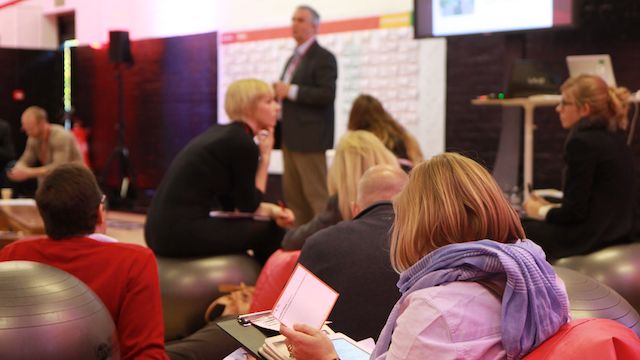
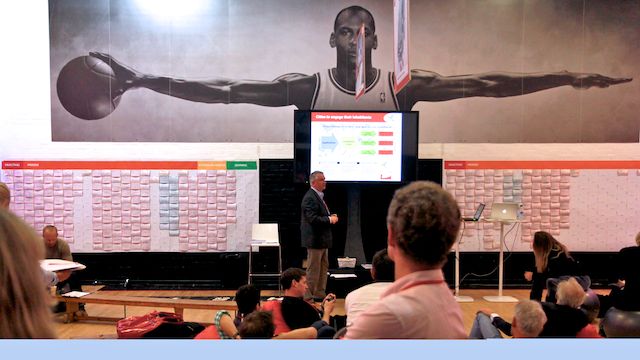
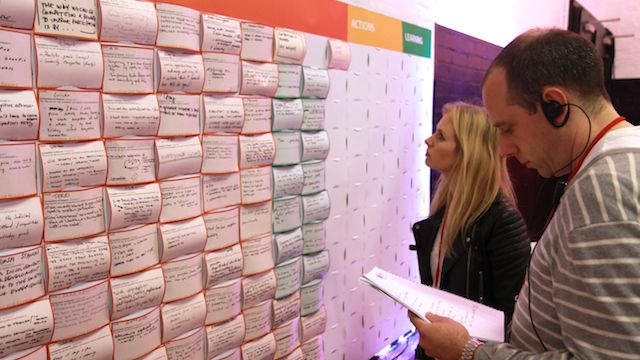
I recently facilitated five important workshops for Coca-Cola at their brilliant Together We Move gathering.
The event bought together active lifestyles experts, academics, coaches and partners from twenty two countries to work-together to address the increasingly critical problem of inactive lifestyles.
Let’s not solve the wrong problem
Physical activity levels are in serious decline and there are costly and negative consequences for people and society.
Coke is a powerful brand and some think their products (and others) are The Problem. But actually low cardio respiratory fitness and inactive lifestyles is a much bigger cause of early death than obesity. Look at the slide above. The big problem is not (primarily) calories in, it’s calories out. And that’s what Together We Move is all about, getting more people to be more active.
Brands change lives
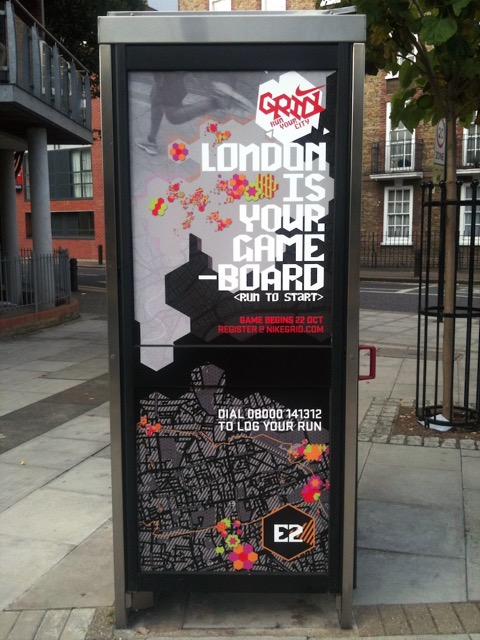
A few years ago, a Nike event, the ‘Nike Grid’ had thousands of Londoners, running between phone boxes to earn points. I entered and was surprised to discover this game had inspired me to run 210km in 2 weeks.
After Nike Grid, flushed with happy success six of team AudioFuel (who compose music for running) signed up to run the Berlin marathon. I ran a 3:43 marathon (in a brand new pair of Nikes) and went from being pretty indifferent about Nike (and a non-marathon runner) to being a fan of Nike.
Then I became a triathlete, and 13 triathlons later I can say Nike changed my life. Maybe Nike saved my life. And now, Coke is coming to save lives. At least that’s my hope.
A cheer for Coke
In times when many corporations don’t act responsibly, all I can report from Together We Move, was a very serious and heartfelt commitment to help more people live active and healthy lifestyles.
It’s brilliant that the good-people at Coke are committed to using their skill and imagination to bring people together, to get more people to be more active.
Game changing ideas
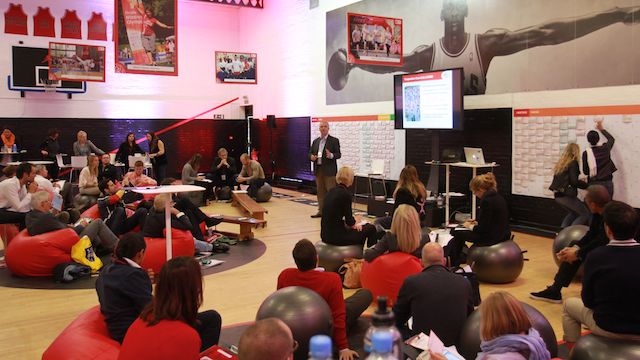
Together We Move was full of insight, ideas and suggestions to re-imagine and re-frame how to solve the right problem. My favourite proposal, made by Fred Turok, Chairman of UK Active, was to give measuring fitness of kids in schools exactly the same importance as measuring numeracy and literacy. Now that would change a generation in a generation, if we could get the right people together to agree to do it.
Together we work?
Mogens Kirkeby, the President of the International Sport and Culture Association rightly said that, ‘what we know together, is more important than what we know alone’.
Mission success will only be achieved by working-together (in things called meetings). If the participants of Together We Move and other stakeholders including other big brands, and politicians, work-together effectively, they may bring twenty first century humans back to life and even save lives, through the simple and beautiful power, of movement.
Sean Blair @ProMeetings @AudioFuel
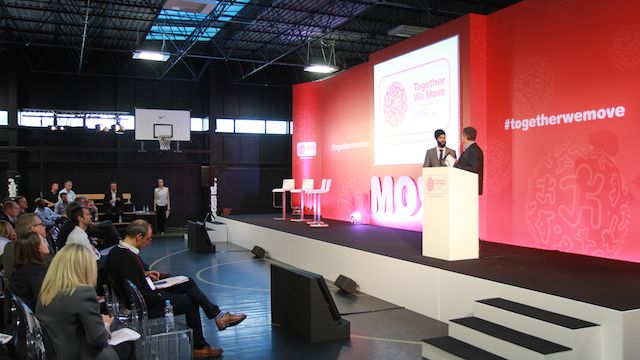
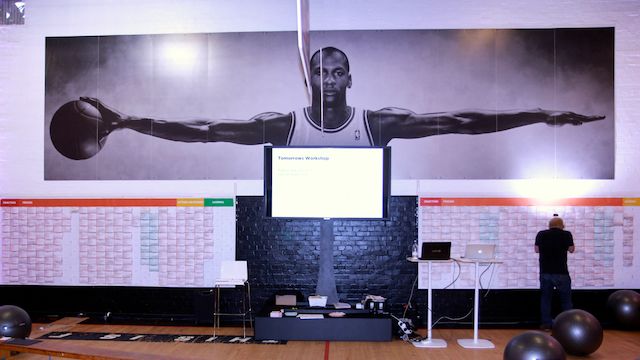
I recently facilitated five important workshops for Coca-Cola at their brilliant Together We Move gathering.
The event bought together active lifestyles experts, academics, coaches and partners from twenty two countries to work-together to address the increasingly critical problem of inactive lifestyles.
Low cardio respiratory fitness causes more deaths than smoking, fat.. Fred Turok #togetherwemove @_ukactive pic.twitter.com/1fXXY4b9Tw
— Sean Blair (@ProMeetings) October 24, 2013
"22% uk population do absolutely no physical activity" Fred Turok, chairman of UK active. #togetherwemove @AudioFuel
— Sean Blair (@ProMeetings) October 24, 2013
Let’s not solve the wrong problem
Physical activity levels are in serious decline and there are costly and negative consequences for people and society.
Coke is a powerful brand and some think their products (and others) are The Problem. But actually low cardio respiratory fitness and inactive lifestyles is a much bigger cause of early death than obesity. Look at the slide above. The big problem is not (primarily) calories in, it’s calories out. And that’s what Together We Move is all about, getting more people to be more active.
Brands change lives
A few years ago, a Nike event, the ‘Nike Grid’ had thousands of Londoners, running between phone boxes to earn points. I entered and was surprised to discover this game had inspired me to run 210km in 2 weeks.
After Nike Grid, flushed with happy success six of team AudioFuel (who compose music for running) signed up to run the Berlin marathon. I ran a 3:43 marathon (in a brand new pair of Nikes) and went from being pretty indifferent about Nike (and a non-marathon runner) to being a fan of Nike.
Then I became a triathlete, and 13 triathlons later I can say Nike changed my life. Maybe Nike saved my life. And now, Coke is coming to save lives. At least that’s my hope.
A cheer for Coke
In times when many corporations don’t act responsibly, all I can report from Together We Move, was a very serious and heartfelt commitment to help more people live active and healthy lifestyles.
It’s brilliant that the good-people at Coke are committed to using their skill and imagination to bring people together, to get more people to be more active.
Game changing ideas
Together We Move was full of insight, ideas and suggestions to re-imagine and re-frame how to solve the right problem. My favourite proposal, made by Fred Turok, Chairman of UK Active, was to give measuring fitness of kids in schools exactly the same importance as measuring numeracy and literacy. Now that would change a generation in a generation, if we could get the right people together to agree to do it.
Together we work?
Mogens Kirkeby, the President of the International Sport and Culture Association rightly said that, ‘what we know together, is more important than what we know alone’.
Mission success will only be achieved by working-together (in things called meetings). If the participants of Together We Move and other stakeholders including other big brands, and politicians, work-together effectively, they may bring twenty first century humans back to life and even save lives, through the simple and beautiful power, of movement.
Sean Blair @ProMeetings @AudioFuel
What happens when 100 people ProMeet in 5 workshops? 667 ideas and insights. #togetherwemove @ProMeetings pic.twitter.com/FxYRGbZGtv
— Sean Blair (@ProMeetings) October 25, 2013
Convenings 2.0
14/10/13 10:42 Filed in: Methods...
Connecting adult learning, communication strategies and event logistics to build stronger relationships
Thanks to the connective power of Twitter, I came across a lovely website, Conferences that work, by Adrian Segar.
Adrian talks a whole lot of sense on his website, and like ProMeet he has a participatory philosophy underpinning his work, I can imagine the conferences he runs have heart and soul, as well as focussing on the content that matters. Lovely.
Convenings 2.0
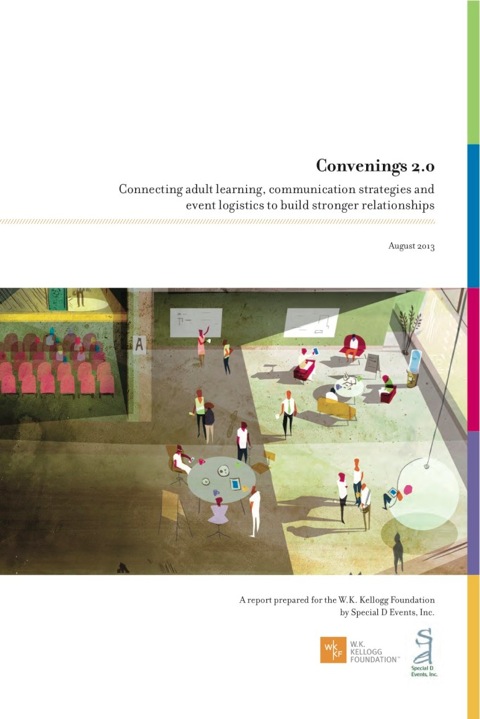
I was also happy to find on Adrian’s website a recent report, Convenings 2.0, a timely and enlightened study that asks what might conferences, events and workshops be like next?
In my view, it is an insightful study that has much to offer.
It’s a 50 pager, so if you want my digest of some key bits consider these extracts.
Extracts from Convenings 2.0
“In 21st century convenings and conferences, knowledge is not only dispensed to, but also created by, the participants.
Exponential growth of information and knowledge has generated the need for not only the mastery of new convening design terms and techniques, but also the innovation and invention of new ways to bring people together for effective learning and problem-solving.
Traditionally in America, knowledge has been transferred from the top down, from master to neophyte, either via the printed page or in classroom settings. This has been going on world- wide since Plato sat with his student on the log.
In the 20th century, some of the media, but not much of the method, began to change.
Fast forward to learners, whether at conventions or colleges, spending countless hours rooted in chairs listening to “experts” explain incomprehensibly complicated PowerPoint frames occasionally punctuated by videos and coffee breaks.
Sometimes 20th century learners, as they endured mind-numbing information dumps, were able to absorb and process valuable information. More often, they ended up drowning in volumes of information they couldn’t possibly absorb aznd being swept away in waves of irrelevance.
This would have continued into the 21st century if it weren’t for one simple fact: learners today obtain information from one another, electronically and instantly. As a result, learning never stops, which means that most learners on any given day are adults. This has important consequences for the designers of communications, conventions, convenings, workshops and conferences.
There is no escape from facing up to the reality of adult learning requirements.”
(C) W K Kellogg Foundation
Convenings 21 recommendations and an attendee bill of rights
The report makes 21 very sensible recommendations teams might use as they plan a conference or event, and finished with a set of expectations (or bill of rights) that attendees might have.
These five stood out, as they are also key to the ProMeet view of the world.
Every voice will be heard.
Clear, specific, well-articulated, achievable and relevant meeting objectives.
Flexible, attendee-driven meeting design.
The application of the principles of adult learning to content delivery.
Informative, useful and timely pre- and post-communications.
You can view and download the Convenings 2.0 report here.
Thanks to the connective power of Twitter, I came across a lovely website, Conferences that work, by Adrian Segar.
Adrian talks a whole lot of sense on his website, and like ProMeet he has a participatory philosophy underpinning his work, I can imagine the conferences he runs have heart and soul, as well as focussing on the content that matters. Lovely.
Convenings 2.0
I was also happy to find on Adrian’s website a recent report, Convenings 2.0, a timely and enlightened study that asks what might conferences, events and workshops be like next?
In my view, it is an insightful study that has much to offer.
It’s a 50 pager, so if you want my digest of some key bits consider these extracts.
Extracts from Convenings 2.0
“In 21st century convenings and conferences, knowledge is not only dispensed to, but also created by, the participants.
Exponential growth of information and knowledge has generated the need for not only the mastery of new convening design terms and techniques, but also the innovation and invention of new ways to bring people together for effective learning and problem-solving.
Traditionally in America, knowledge has been transferred from the top down, from master to neophyte, either via the printed page or in classroom settings. This has been going on world- wide since Plato sat with his student on the log.
In the 20th century, some of the media, but not much of the method, began to change.
Fast forward to learners, whether at conventions or colleges, spending countless hours rooted in chairs listening to “experts” explain incomprehensibly complicated PowerPoint frames occasionally punctuated by videos and coffee breaks.
Sometimes 20th century learners, as they endured mind-numbing information dumps, were able to absorb and process valuable information. More often, they ended up drowning in volumes of information they couldn’t possibly absorb aznd being swept away in waves of irrelevance.
This would have continued into the 21st century if it weren’t for one simple fact: learners today obtain information from one another, electronically and instantly. As a result, learning never stops, which means that most learners on any given day are adults. This has important consequences for the designers of communications, conventions, convenings, workshops and conferences.
There is no escape from facing up to the reality of adult learning requirements.”
(C) W K Kellogg Foundation
Convenings 21 recommendations and an attendee bill of rights
The report makes 21 very sensible recommendations teams might use as they plan a conference or event, and finished with a set of expectations (or bill of rights) that attendees might have.
These five stood out, as they are also key to the ProMeet view of the world.
Every voice will be heard.
Clear, specific, well-articulated, achievable and relevant meeting objectives.
Flexible, attendee-driven meeting design.
The application of the principles of adult learning to content delivery.
Informative, useful and timely pre- and post-communications.
You can view and download the Convenings 2.0 report here.
Be Insanely Brilliant
Backdrops for creative workshops
I call these characters members of the ‘Boss’ family.
They are being used in briefing materials, the back of gridcards, and in other ways to help inspire people to think and be creative in my workshops.
Getting visual is exciting and fun, so I think you’ll be seeing more of these characters and other illustrations.


I call these characters members of the ‘Boss’ family.
They are being used in briefing materials, the back of gridcards, and in other ways to help inspire people to think and be creative in my workshops.
Getting visual is exciting and fun, so I think you’ll be seeing more of these characters and other illustrations.
Wallchart and Gridcards - 100% Helpful
01/10/13 15:54 Filed in: Methods... | ProMeet Photos... | Wallchart... | Gridcard... | Evaluation... | Clients...
Tools to help teams be more effective
I had the pleasure of facilitating a planning meeting for a high street retailer yesterday.
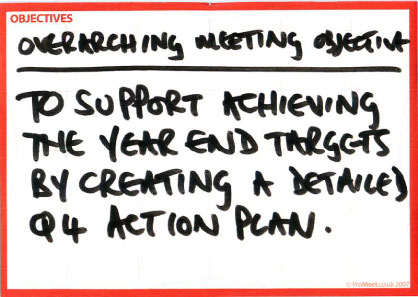
The overarching meeting objective was to create a detailed Q4 action plan.
And the ‘agenda’ took the form of seven specific meeting objectives:
1. To prioritise the operations team objectives - from those vital to the year end targets to those ideal to support the year end targets
2. To identify any missing and vital objectives
3. To action plan the vital objectives
4. To action plan the important objectives
5. To identify any organisation wide dependencies and identify requests and suggestions to other parts of the company
6. To learn about continuous improvement
7. To evaluate the effectiveness of the meeting
Having not worked with a chain of shops in the run up to Christmas before I was struck by how busy the ‘golden quarter’ is for retailers, and just how hard the guys at HQ, and in-store need to work to create brand experiences for customers and strive to meet targets.
I’d wager a few weary souls might not make it to the end of their Christmas party. ZZzzzz.
They are going to be busy.
Evaluation of ProMeet tools
The end-of-meeting evaluation asked participants to evaluate the effectiveness of the meeting.
Question 6 asked people to assess the use of a wallchart and gridcards.
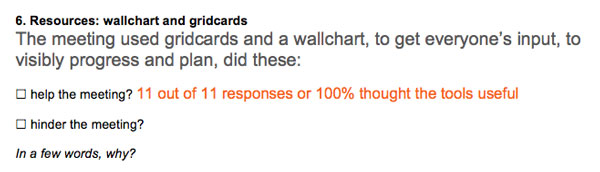
Participant comments are a concise validation of the helpfulness of these tools.
“I liked seeing it all mapped out on the wall.”
“Good to be able to look back and think over earlier observations.”
“Sets out a clear process.”
“Great visual aid.”
“Ensure everyone participated and had a say.”
“Can refer back to it at any point.”
“Could see all the points made throughout the meeting.”
“Encourage across the board communications.”
“Short, concise, very visual. Motivational to see all ideas & collaborative input.”
Why so helpful?
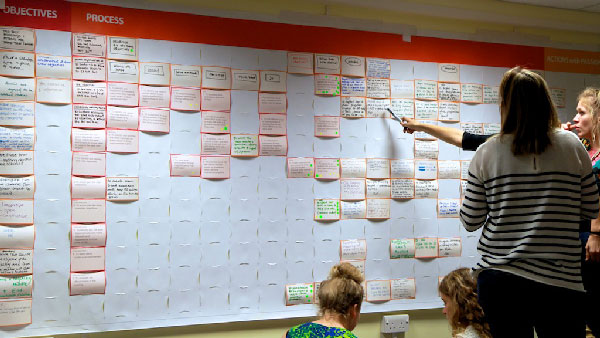
The visual nature of these tools could be one of the reasons people find them so helpful. Generally in meetings peoples visual attention could be placed pretty much anywhere. Certainly it’s unlikely that everyone will be focussed on the same thing at the same time.
At several points in this meeting I asked participants to stand in front of the wallchart, evaluate different data sets and make choices about priorities.
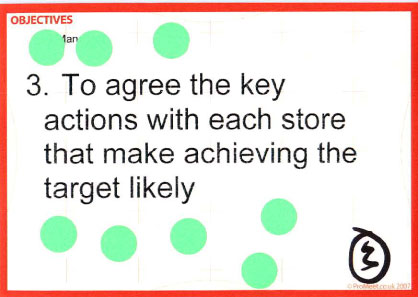
The group had every individual view written on gridcards and mapped on the wallchart to refer back too, to help them decide which of many positions was the most important.
Using sticky dots to express individual views quickly helped the group agree, without lengthy debate, which 6 of the 20 team objectives were most important to achieve fully.
This process then allowed the group to spend the majority of the meeting time action planning, which they completed very thoroughly indeed.
I had the pleasure of facilitating a planning meeting for a high street retailer yesterday.
The overarching meeting objective was to create a detailed Q4 action plan.
And the ‘agenda’ took the form of seven specific meeting objectives:
1. To prioritise the operations team objectives - from those vital to the year end targets to those ideal to support the year end targets
2. To identify any missing and vital objectives
3. To action plan the vital objectives
4. To action plan the important objectives
5. To identify any organisation wide dependencies and identify requests and suggestions to other parts of the company
6. To learn about continuous improvement
7. To evaluate the effectiveness of the meeting
Having not worked with a chain of shops in the run up to Christmas before I was struck by how busy the ‘golden quarter’ is for retailers, and just how hard the guys at HQ, and in-store need to work to create brand experiences for customers and strive to meet targets.
I’d wager a few weary souls might not make it to the end of their Christmas party. ZZzzzz.
They are going to be busy.
Evaluation of ProMeet tools
The end-of-meeting evaluation asked participants to evaluate the effectiveness of the meeting.
Question 6 asked people to assess the use of a wallchart and gridcards.
Participant comments are a concise validation of the helpfulness of these tools.
“I liked seeing it all mapped out on the wall.”
“Good to be able to look back and think over earlier observations.”
“Sets out a clear process.”
“Great visual aid.”
“Ensure everyone participated and had a say.”
“Can refer back to it at any point.”
“Could see all the points made throughout the meeting.”
“Encourage across the board communications.”
“Short, concise, very visual. Motivational to see all ideas & collaborative input.”
Why so helpful?
The visual nature of these tools could be one of the reasons people find them so helpful. Generally in meetings peoples visual attention could be placed pretty much anywhere. Certainly it’s unlikely that everyone will be focussed on the same thing at the same time.
At several points in this meeting I asked participants to stand in front of the wallchart, evaluate different data sets and make choices about priorities.
The group had every individual view written on gridcards and mapped on the wallchart to refer back too, to help them decide which of many positions was the most important.
Using sticky dots to express individual views quickly helped the group agree, without lengthy debate, which 6 of the 20 team objectives were most important to achieve fully.
This process then allowed the group to spend the majority of the meeting time action planning, which they completed very thoroughly indeed.