
Sep 2013
A short (and personal) history of Leading Change
04/09/13 09:29 Filed in: Leadership... | Leading Change...
Change. Now a permanent process, not a one off event.
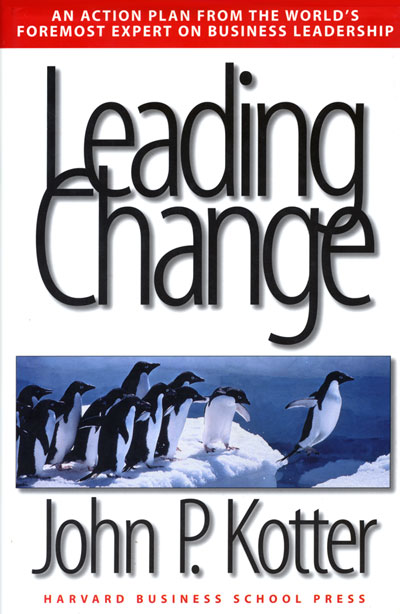
Back in the somewhat more sedentary times of 1996, US academic John Kotter published Leading Change.
By examining the change efforts of 100 companies he sought to understand the successes and failures leaders made during change and codify an approach leaders could adopt when leading large organisational change programmes.
His approach was summarised in an eight stage process.
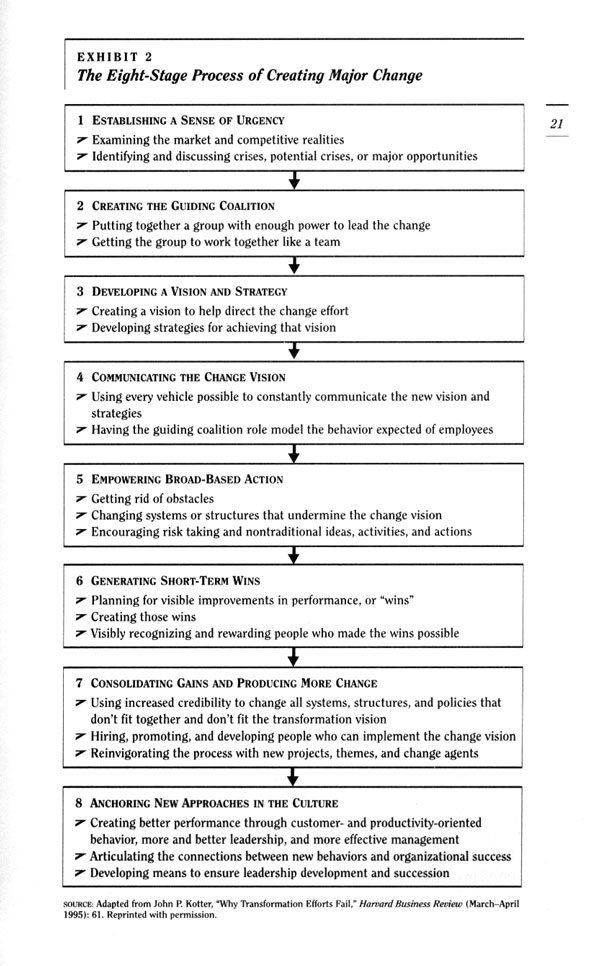
© John Kotter
At the time Kotter published I was a director of the Design Council and we looked to Kotter’s ideas to help us think about restructuring the organisation to better fit the vision and strategy that we had inherited after the Sorrell Review.
Having a ‘map’ to think about the steps was helpful, the logic implicit in Kotter’s model was useful and the journey we undertook was better for it.
Times change faster than leading change?
Looking back, Kotter’s 1996 account of leading change seems to fit less well in the very turbulent times we now live in.
Kotters model lacks the agility the current pace of change requires.
It looks a bit like a single use process, to switch on when change is needed, and then it’s back-to-business-as-usual.
To be fair to Kotter, in 2012 he gave his model a spring clean and added a couple of extra ideas to his original thinking, but his 8 step model is still the back bone of his account of leading change.
His recent paper was published in the Harvard Business Review, and is called Accelerate. Read it at HBR, or download a copy free from Kotters website, it’s worth a look.
Living Vision, Emergent Strategy
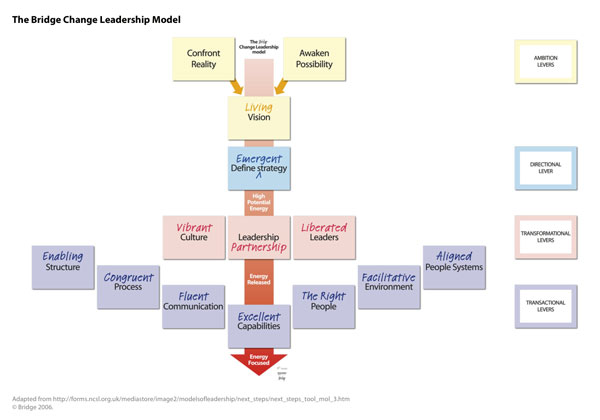
In 2006 when I was working with the Department for Education and Skills Innovation Unit I came across the Bridge Model of Change Leadership.
© Bridge 2006
What stood out in this account of leading change were the ideas that vision might be living (and therefore evolving, growing) and that strategy might be emergent, (and therefore able to change).
A model of change able to adapt to change. Brilliant.
The other two features of this model that I liked are the idea of leadership partnerships, and that it asks questions at the level of operation (the ‘Transaction levers’).
In a networked world, leadership can no longer simply be leadership of employees, but leadership with partners, suppliers, even competitors or customers.
Leadership Partnerships. Brilliant.
A Resilience Architecture
Of course there’s no one right way of leading change. What might work for a charity, might not work for a large corporation or a family business. But there might be some common principles.
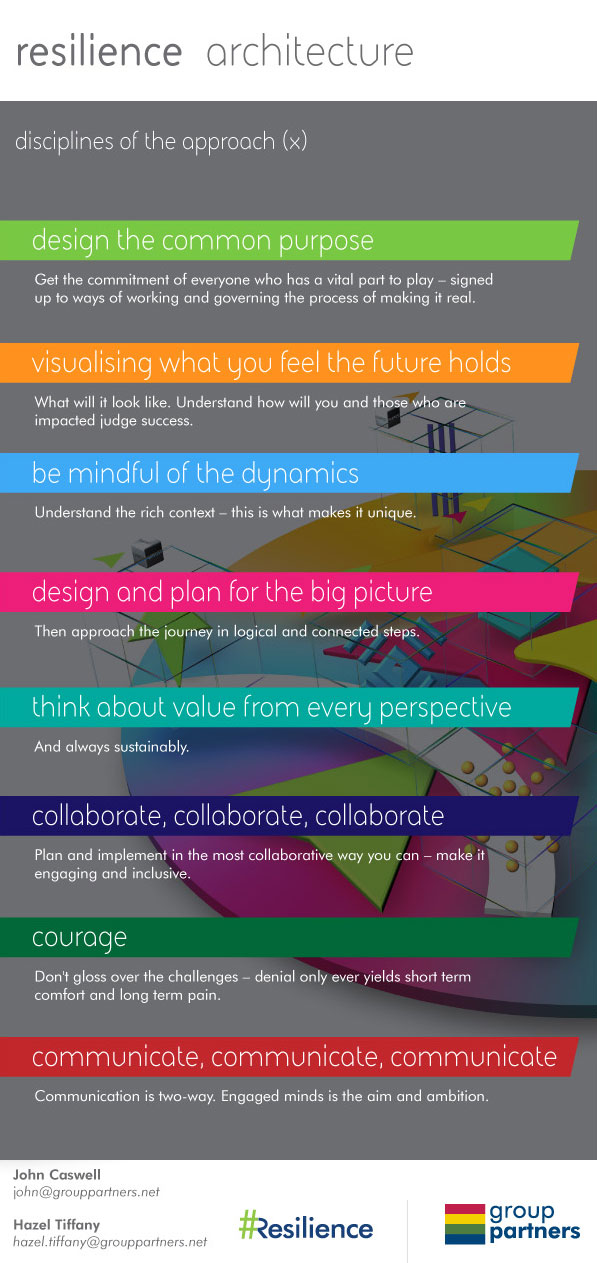
I came across a model created by a John Caswell and Hazel Tiffany from Group Partners.
They call it a resilience architecture.
© Group Partners 2013
I’m not sure what they mean by a ‘resilience architecture’ but to me it looks like an excellent set of ideas to adopt while leading change. I know John, and he’s an inveterate model builder, so while you’re here have a look at his 21st Century credo, then we’ll look for any common ideas.
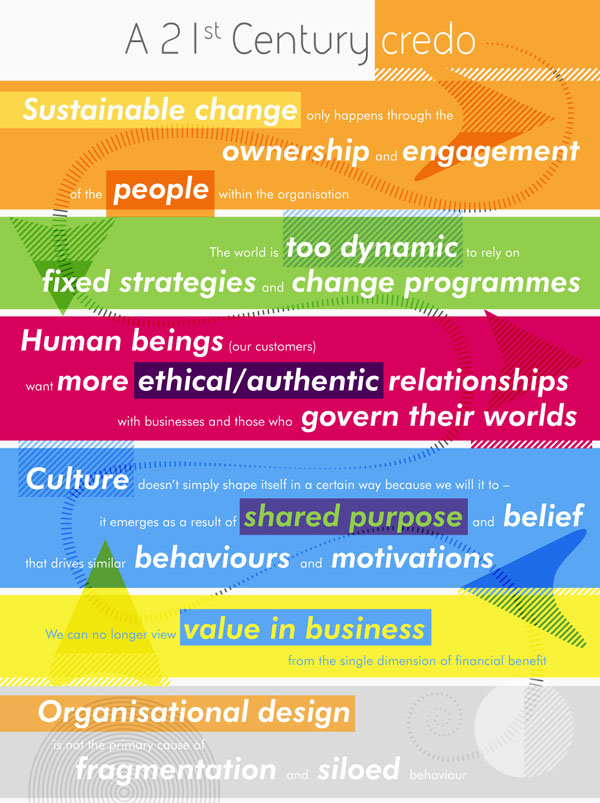
© Group Partners 2013
Principles
Looking across the ideas about change leadership from a management guru and two businesses that offer very different approaches to change management, what conclusions can be made? (Or if I stole the best bits, with the experiences and prejudices I inevitably hold what principles would I draw out?)
1. Understand the changing context
2. Embrace participation and collaboration
3. Seek purpose and meaning
4. Be agile, fluent and allow emergence
5. Real communication
6. Learn alone. Lean together.
I’ve been lucky enough to work with some brilliant people in ‘ProMeeting change processes’, often using the ideas of participatory leadership.
There seems little doubt change will continue to place demands on us all, and that change leadership will need to be a competency we’ll all need to be brilliant at.
No doubt the ideas that underpin change will change too, but I’d bet some ideas will remain timeless.
What is Strategic Illustration?
01/09/13 14:47 Filed in: Strategic Illustration...
A picture might save a thousand (forgotten) words.
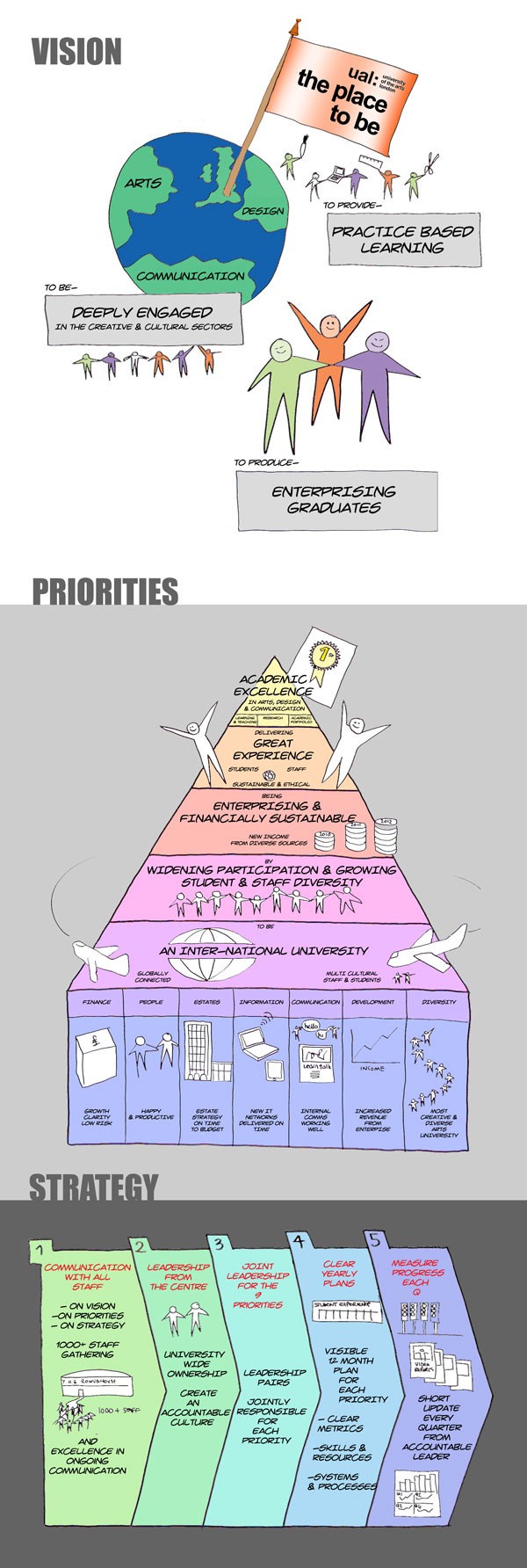
Strategic Illustration by Sean Blair
I think the least memorable (and no doubt least read or understood) strategy document I have seen weighed in at just under 100 pages.
One has to wonder what the purpose of such a document is.
A text heavy word document is not going to help make an organisations vision or strategy memorable, and the 100 pager I referred to was not exactly a page turner. I honestly wondered if anyone had actually read the whole thing?
Keeping plans visible
The wallchart and gridcard system we use is excellent for gathering all ideas, views and perspectives, quickly and succinctly, and it is very very flexible.
It is also useful to keep plans highly visible, and in helping teams regularly be guided by and held accountable to agreed plans, and just as importantly in the fast changing world share learning from plans that seem quickly redundant and update plans easily.
But wallchart full of gridcards does not summarise a vision, plan or strategy visually and some believe that working in pictures, especially on tasks that require creative or innovative approaches helps groups engage the creative visual side of the brain, aiding creative thinking.
What is Strategic Illustration?
I was taught strategic illustration by Chris Chopyak, from Alchemy, and she defines it as such:
“Strategic Illustration is a process of creatively engaging people to work together to develop a “picture” of a vision, plan, product, message, and story.
We all process information differently. Using graphics, colour and metaphor allows us to process complex information visually and completely. Highly illustrated maps simplify content, employ right and left brain modalities to help us understand our situations, opportunities and challenges with clarity and accuracy.
The maps are retained by the client and used to help focus actions and business decisions.”
Maps and templates
You don’t need a facilitator to try using visual thinking. Strategic Illustration pioneers the Grove have a set of maps and templates you can buy to try it for yourself.
A couple of the blank templates that I like are shown here (these are (C) the Grove)
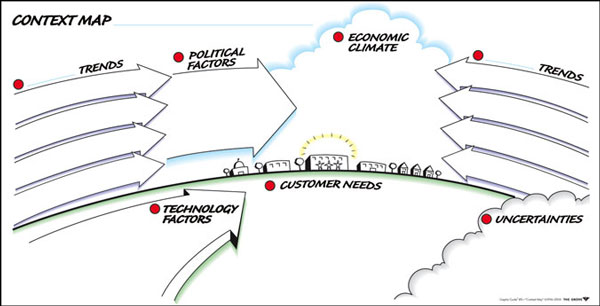
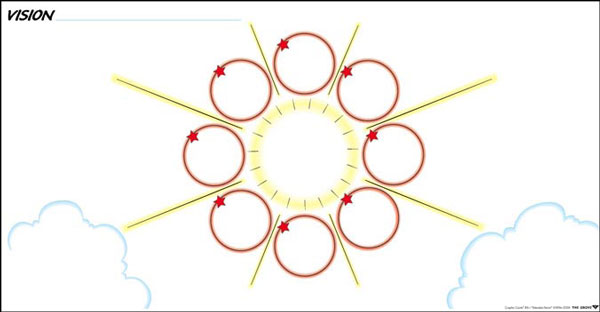
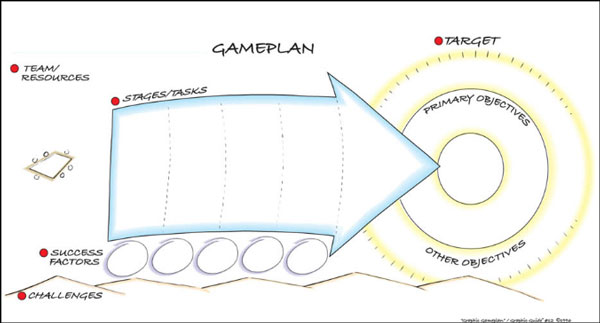
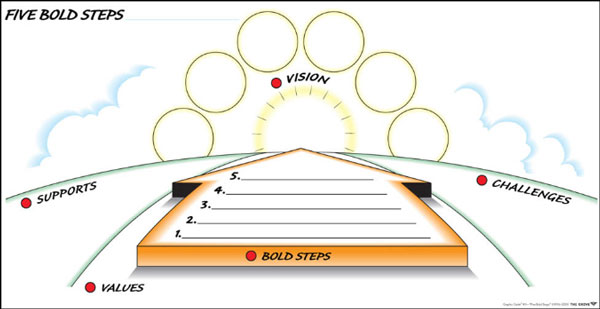
You can see that with this set of four maps a group could, in a couple of hours:
- look at the changing context
- see different perspectives on a vision, and unify those into a single articulation
- plan key objectives and set out key stages / milestones
- identify five bold steps that might make a difference to implementation of a plan
Grove have 20 in total to choose from, see them all here.
Visible living plans
As well as encouraging creative thinking, the ability of strategic illustrations to live on and be a constant reminder of what’s important is a very helpful way of having goals, strategies and visions that live on day to day, something not likely in a chunky word document.
A well thought through and artistically produced set of illustrations can be reproduced to be visible in many sites and I’ve seen them used as screen savers, and even mouse mats.
If you’re dreading the yearly business planning cycle then why not try a fresh approach. If you need help, get in touch.