At an International Association of Facilitators meet-up in London, Sharon O'Regan asked us to share ideas for handling the person in a meeting who won't stop talking. In an entertaining discussion, ten ideas emerged. Here they are, with what I have learned using them since.
Prevent it
1. Contract with the group first
In the preparation phase, agree ground rules and how you will intervene if someone talks for too long. An intervention the group has agreed to in advance feels like help, not rudeness.
2. Offer the group its own signal
Give participants a light-hearted way to tell each other it is time to move on. Martin Gilbraith suggests making rabbit ears with both hands, for when someone is rabbiting on.
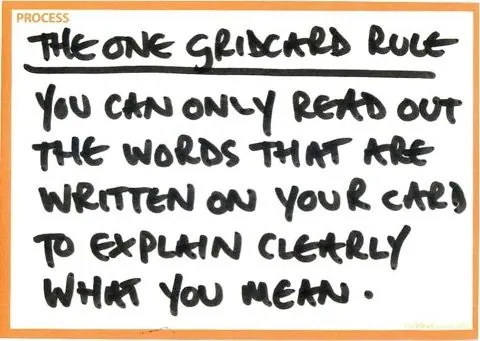
3. Invoke the one gridcard rule
Ask people to write their point on a single gridcard instead of speaking it. Thirty words with a fat pen is a natural limit.
Manage it in the moment
4. Move closer
As the facilitator, move gradually closer to the person speaking and into their field of vision. Your presence and gestures can signal it is time to conclude without a word being said.
5. Count speakers down
Brief speakers that you will hold up five fingers with five minutes to go, and keep your hand up until they have seen it. Then count down at three, two and one.
6. Use a visible clock
Agree with the group that a projected countdown marks the end of each input, and that when it reaches zero everyone applauds, whether the speaker has finished or not.
7. Find the pause
Wait for a pause, even a tiny one, and gently ask: "Should we move on?"
8. Name what is happening
Interrupt, with permission, to bring the group's attention to the pattern: "Can I pause us for a moment? I'd like to draw everyone's attention to what is happening right now." Used with care, this becomes learning for the whole group, not a rebuke for one person.
Move on, move on: the MOMO card
Inspired by Jonathan Ling, then an HR manager at Thames Valley Housing, we made a gridcard for groups to use with each other: MOMO, for Move On, Move On.
9. Try MOMO
Used with respect, good grace and humour, MOMO directs attention and builds individual and group awareness while keeping things moving.
- Offer it as an experiment. At the start, propose MOMO as a ground rule for this meeting only, to learn about keeping meetings moving. Ask if people are willing.
- Agree the rules. Use it without malice. Call MOMO on behalf of everyone, not for yourself: there is no point moving on if most people have not understood. Anyone may challenge a MOMO ("I haven't understood Fred's point yet"). Receiving a MOMO card does not make you wrong; it tells you that you have been heard.
- Hand out the cards and get on with the meeting.
- Learn from it. Make time at the end to ask: how was MOMO for the meeting, and for each of us?


10. And if all else fails
For groups comfortable being rude with humour, there is SUMO: Shut Up and Move On. Or, as one colleague did, pass round a box of earplugs as a visible sign that enough is enough.
MOMO card (PDF) SUMO card (PDF) One gridcard rule (PDF)
Thanks to Martin Gilbraith, Julia Goga Cooke, Mary Higgins, Nikki Wilson, Sharon O'Regan, Martin Farrell and Nihal Salah for the original conversation. For more on when to step in and when to stay out of the way, read facilitator presence.
Sean Blair is the founder of ProMeet and Serious Outcomes, an IAF Certified Professional Facilitator and a LEGO® Serious Play® Master Trainer. About Sean.