This is a gridcard. It is made from 160gsm card and is A6 in size, 105 by 148 millimetres. It is just a piece of card for people to write on, but this simple device has eight ways to help you have better meetings.
Eight things a gridcard does
1. Democratise
Power does odd things in meetings. Sometimes people don't say what they think; sometimes they don't speak at all. Asking everyone to write their view on a gridcard at the same time democratises the meeting and lets every voice be heard, including the quiet ones and the junior ones.
2. Save time
Some people take a long time to make a simple point, or no point at all. Even verbose people need only about 60 seconds to write their view on an important question with a fat pen, which allows about 30 words. Gridcards cut waffle.
3. Diversify
Good decisions are informed by a wide range of opinions and perspectives, and sometimes the lone voice holds the best insight. Gridcards collect diverse thinking simultaneously, before anyone has been swayed by the first or loudest speaker.
4. Unify and focus
It is hard, especially in larger meetings, to focus everyone's attention on the same thing at the same time. Gridcards, and their home on a wallchart, help a group think together about one question at a time.
5. Record
Gridcards create a record of every idea, decision and plan without anyone taking minutes. Stacked and scanned properly (see below), they become a clear account of the work done. One roadmap workshop for leaders of the UK hydrogen and fuel cell sector produced 17 stacks of cards.
6. Increase energy
Someone droning on drains energy from a meeting. Gridcards create a more staccato rhythm of individual reflection, collective sharing and group meaning-making. In workshops, getting up to post cards on the wall adds movement too.
7. Connect
Without lengthy discussion it is hard to connect the three most important ideas in 20 people's heads. On a wall, the most important ideas sit side by side, connecting thinking on the question in hand and from earlier in the meeting.
8. Show progress
As a wall fills with ideas, insights, plans, decisions, actions and learning, groups report real satisfaction that their time together has made visible progress.
What participants say about wallcharts and gridcards
At a planning meeting for a high street retailer, the operations team needed a detailed plan for the busy fourth quarter. The agenda was seven objectives, starting with "Prioritise the operations team objectives". At the end we asked participants to evaluate the wallchart and gridcards. Their comments are a concise case for the tools:
- "I liked seeing it all mapped out on the wall."
- "Good to be able to look back and think over earlier observations."
- "Ensured everyone participated and had a say."
- "Short, concise, very visual. Motivational to see all ideas and collaborative input."
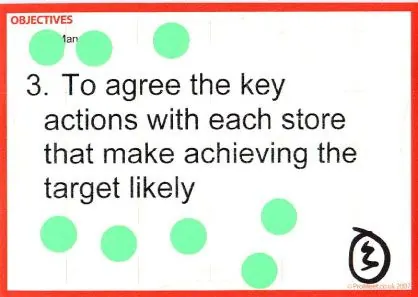
Because every individual view was on the wall, the group could use sticky dots to agree, without lengthy debate, which 6 of 20 team objectives mattered most. That left most of the meeting for action planning. The sponsor, Cecily Mills of Oliver Bonas, said ProMeet "enabled us to get straight to the point and action plan key objectives to deliver our strategic plan."
After the meeting: managing the cards
A wallchart full of gridcards is a system at the edge of chaos. Managing the cards afterwards is what makes the work usable. There are four steps.
- Photograph, then stack. Photograph the full wallchart first, so you can rebuild it if a stack gets jumbled. Then work from the left (the objectives end), taking each column top to bottom so the card describing the task sits on top. Place each stack on the floor beneath its column, and separate stacks with a spare folded card.
- Scan. Scan each stack straight after the meeting on a fast document scanner set to A6, single-sided, creating one PDF per stack. A phone scanning app works for smaller meetings.
- Name and share. Rename each file with the date, stack number and name, for example
2026_03_14_02_Changing context.pdf, store them in a shared folder and send the link to everyone who came. - Store or recycle. Keep the paper cards you will review next time, such as actions, for a year or so, with the meeting name and date on the top card and an elastic band round the stack.
Try it yourself
You can print your own gridcards. The artwork and the method card are free to download.
Gridcard artwork (PDF) Gridcard management method card (PDF) ProMeet wallchart (PDF)
Gridcards are the heart of the ProMeet method. If you would like a facilitator to run your next important meeting this way, see meeting facilitation.
Sean Blair is the founder of ProMeet and Serious Outcomes, an IAF Certified Professional Facilitator and a LEGO® Serious Play® Master Trainer. About Sean.