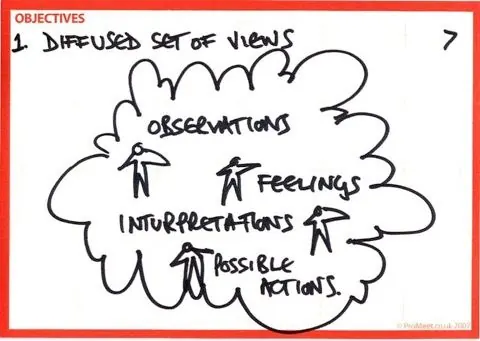
Focused conversation, often called ORID, helps a diverse group with different ideas, feelings, observations and interpretations reach an informed consensus about how to act. It is one of the simplest and most useful methods a facilitator or chair can learn.
The method was developed by the Institute of Cultural Affairs as part of its Technology of Participation. I first heard it explained by Martin Gilbraith, a former chair of the International Association of Facilitators, and we have used it in ProMeet meetings ever since.
The four stages
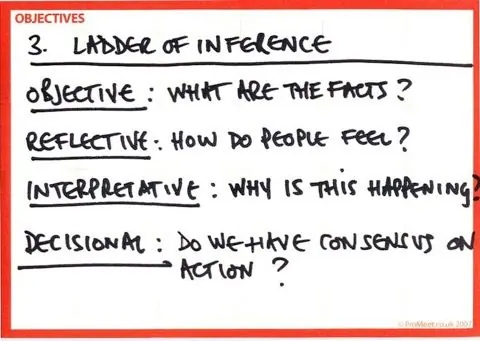
ORID asks questions at four levels, in order. Each level builds on the one before.
- Objective: the facts. What did we see, hear or read? Data, not opinions. Everyone starts from the same shared information.
- Reflective: the feelings. How do we react? What surprised, pleased or worried us? Feelings are data too, and naming them stops them leaking out later.
- Interpretive: the meaning. What does this mean for us? What are the implications? What have we learned?
- Decisional: the action. What will we do? What is our decision, and what is the next step?
Example questions
Suppose a leadership team has just received the results of an employee survey.
- Objective: Which numbers stand out? What did people say in their own words?
- Reflective: What surprised you? Where did you feel uncomfortable?
- Interpretive: What is this telling us about how it feels to work here? What patterns do we see?
- Decisional: What are the two or three things we will change? Who will lead each one, and by when?
Why it works
The method draws on Chris Argyris's work on advocacy and inquiry, and his "ladder of inference". Most disagreements happen because people jump straight to conclusions, each from a different set of facts and feelings. ORID walks the group up the ladder together, one rung at a time. People with different learning styles and ways of seeing engage with the "truth" as they see it, and the decision that emerges takes account of everyone's facts, feelings and interpretations.
Tips for using ORID
- Don't skip the reflective stage. Senior groups often want to. It is usually where the real issue is.
- Prepare two or three questions per stage, then choose in the moment.
- Capture answers on gridcards, one column per stage, so the group sees its thinking build.
- Keep it short. A focused conversation can take 15 minutes or two hours. Match it to the decision.
ORID is one of the tools in the ProMeet method. For testing whether a group really agrees with the decision it reaches, see Scales of Agreement.
Sean Blair is the founder of ProMeet and Serious Outcomes, an IAF Certified Professional Facilitator and a LEGO® Serious Play® Master Trainer. About Sean.