"So, we're all in agreement then?" Silence is taken for consent, the meeting moves on, and three weeks later the decision quietly unravels. Scales of Agreement is a quick way to test decisions and responses to proposals while making sure every view is heard.
It is participatory, so it builds ownership of ideas as well as interrogating them. Used with no hidden agenda on key decisions, it seeks out the vital dissenting minority. It can also be used more simply as voting with comments.
The eight scales of agreement
| Position | What it sounds like |
|---|---|
| Full agreement | "I like it." |
| Agreement, with a minor point of contention | "Basically I like it, but..." |
| Agreement with reservations | "OK, but I have a question or concern." |
| Abstain | "I'm indifferent." |
| Stand aside | "I don't like this, but I won't hold up the group." |
| Disagreement, but willing to go with the majority | "I want my disagreement noted, but I'll support the decision." |
| Disagreement, with a request not to be responsible for implementation | "I won't stop it, but I want no part of it." |
| Block | "I veto this proposal." |
Where the cards cluster tells you the strength of support. A cluster at the top means enthusiastic support; around the middle, lukewarm or ambiguous support; towards the bottom, meagre support. The comments tell you why.
How to run it
- Clarify the proposal. If there are several, separate them.
- Take questions for clarification, so everyone is responding to the same thing.
- Explain the eight positions.
- Lay the eight positions in a line, in order, on the floor, a table or a wall.
- Give everyone a gridcard or sticky note.
- Ask people to work in silence. Each person writes the position they take and a question or comment that explains it.
- When everyone has finished, invite each person to read out their position and comment, then place their card by the matching position.
- Read the clusters together. Where is the group, and what do the comments tell you about the decision?
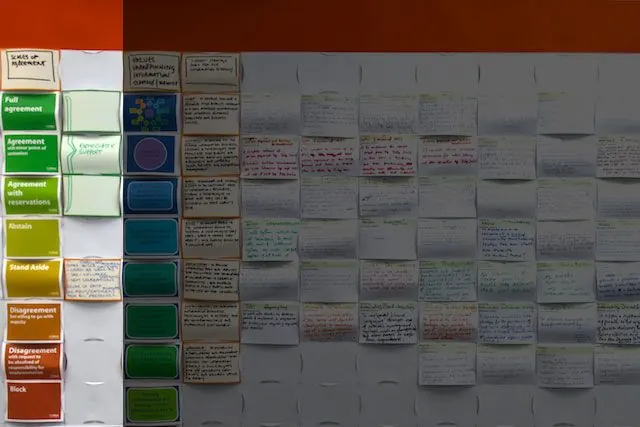
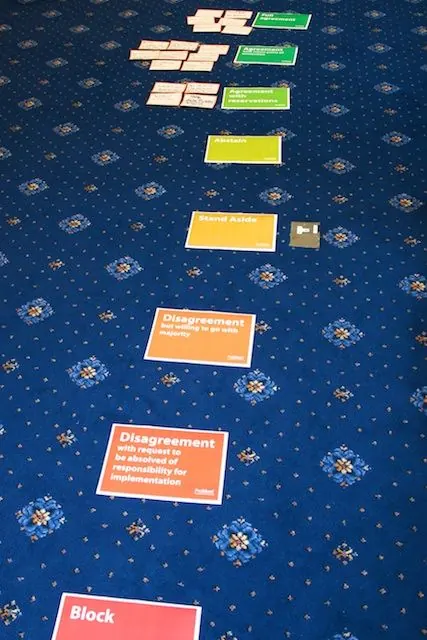
I find the floor fastest. Getting people out of their seats brings energy back to the room, and a cluster of bodies is hard to ignore.
First, choose your decision rule
A decision is the point between discussion and action. Many meetings fail at this point because nobody is clear which kind of decision is being made. There are five common decision rules, and each suits different stakes:
- Unanimous agreement. Powerful when there is time to understand each other's views, so that new proposals can emerge from that understanding. Scales of Agreement is built for this.
- Majority vote. Quick, but produces winners and losers. Useful when speed matters more than quality.
- The person in charge decides after discussion. Common for high-stakes decisions, and works well if people say what they really think first.
- The person in charge decides without discussion. Useful in a crisis. The higher the stakes, the riskier it is.
- Flip a coin. Not for important decisions, but how much discussion do you really need to decide whether to break now or in half an hour?
Say which rule you are using before the decision, not after. Then use a few minutes at the end of the meeting to learn about the upsides and costs of the rule you used.
Method card (PDF) Floor cards, A4 (PDF) Wallchart cards, A6 (PDF) Decision rules method card (PDF)
At the Department for Work and Pensions, an independent evaluation found 82% of participants preferred ProMeet to their usual way of meeting. Read more about the ProMeet method, or the earlier step: reaching a decision with ORID.
Sean Blair is the founder of ProMeet and Serious Outcomes, an IAF Certified Professional Facilitator and a LEGO® Serious Play® Master Trainer. About Sean.