The least memorable strategy document I have ever seen ran to just under 100 pages. I honestly wondered whether anyone had read the whole thing. A text-heavy document will not make a vision or strategy memorable. A picture can.
A picture to save a thousand forgotten words
I was taught strategic illustration by Chris Chopyak of Alchemy, who describes it as a process of creatively engaging people to work together to develop a picture of a vision, plan, product, message or story. Graphics, colour and metaphor help us process complex information visually. Well-made maps simplify content and help people understand their situation, opportunities and challenges clearly. The client keeps the maps and uses them to focus actions and decisions.
Our wallchart and gridcard system is excellent for gathering every idea quickly. But a wall full of gridcards does not summarise a vision or strategy visually. Working in pictures, especially on creative tasks, engages a different kind of thinking, and the result lives on long after the meeting.
Three ways to use illustration in workshops
It helps to distinguish three uses of hand-drawn images in meetings and workshops.
- Wall decorations evoke emotions or express wishes. Done well, they set the tone for a meeting. Done badly, or out of step with the culture of the group, they can seem trite.
- Graphic recording captures in pictures and words what is said, as it is said. It is engaging and memorable, but can look messy and rarely shows what matters most.
- Strategic illustration brings key points to life to help explain them. It needs more thought and preparation, and the illustrator needs guidance on the key ideas, but it gives people a clear, memorable way to see complex information.
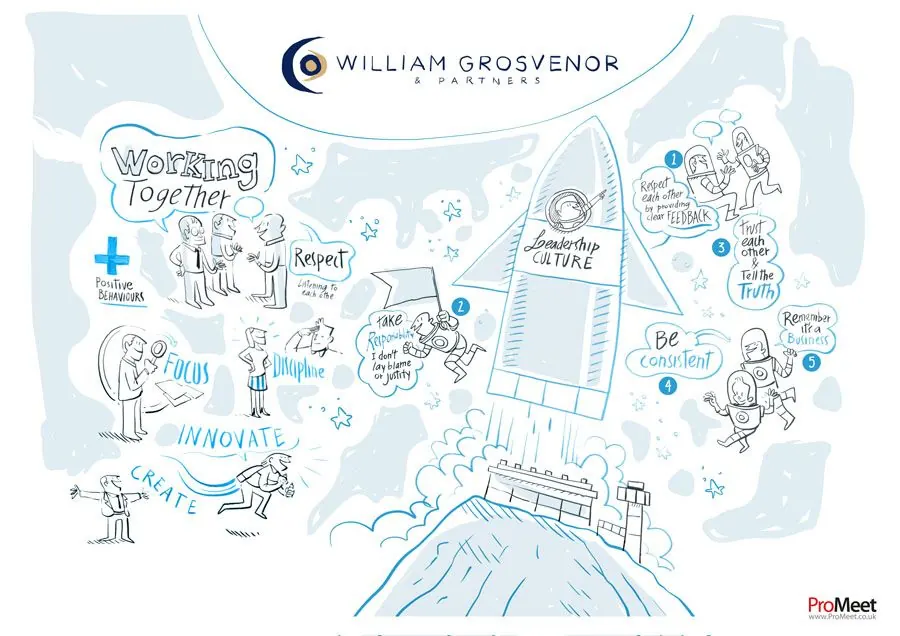
Example: a ten-year roadmap in a day
For the Technology Strategy Board (now Innovate UK) we facilitated a workshop at Sadler's Wells for leaders of the UK hydrogen and fuel cell sector. The aim was a ten-year roadmap for the sector, and the overarching objective was "To strengthen and grow the UK hydrogen fuel cell sector". By the end of the day, participants had:
- drafted a ten-year vision
- considered the risks and opportunities of horizon issues
- agreed the biggest sector challenges and opportunities
- identified ideas for interventions to move the sector forward
- drafted 23 outline intervention plans
- created an outline roadmap and plan
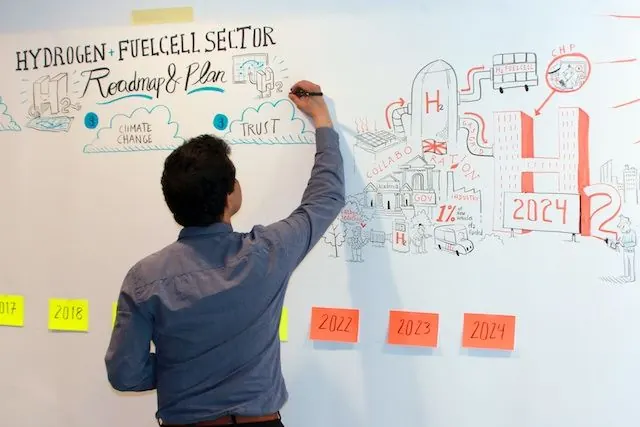
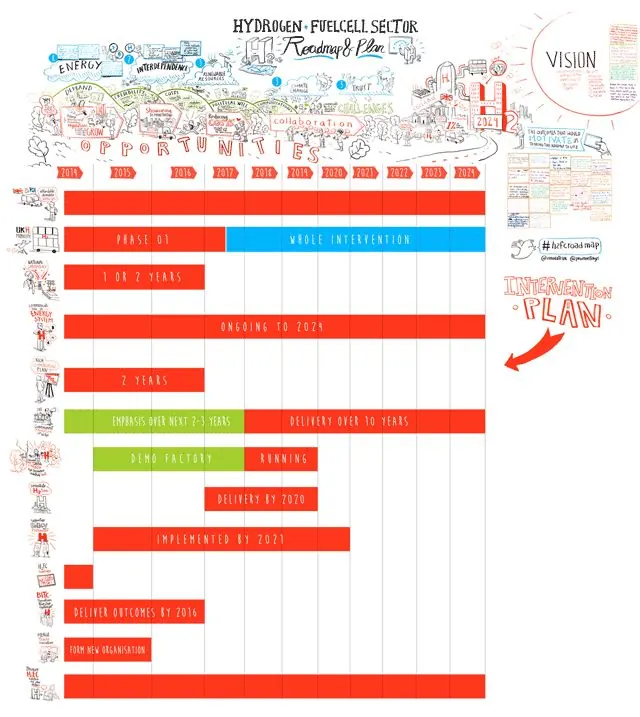
Gridcards captured every point from every person. Illustrator David Vignolli recorded the key points as a strategic illustration during the day, and the intervention plan was added afterwards. Elizabeth Flint, the lead technologist who commissioned it, said the work "transformed the way I am approaching a new piece of work".
See the full illustration (PNG)

Try it yourself
You do not need a facilitator to start thinking visually. The Grove publishes graphic templates for context mapping, vision, game plans and bold steps, which let a group look at the changing context, unify different perspectives into one vision, plan milestones and pick bold next steps in a couple of hours. A good set of illustrations can then be reproduced wherever people work: on walls, in reports, even as screensavers.
We use strategic illustration in strategy workshops where the plan has to be shared and remembered across an organisation or a whole sector.
Sean Blair is the founder of ProMeet and Serious Outcomes, an IAF Certified Professional Facilitator and a LEGO® Serious Play® Master Trainer. About Sean.